
Share:

Knowledge

Employment news | October 2025

Andersen's Labour Law team analyses the most interesting regulations and rulings from September
REGULATIONS

Public consultation and urgent procedure regarding the registration of working hours.

  • In view of the difficulties approving the bill to reduce working hours, the Ministry of Labor opened a public consultation that took place between September 12 and 26, 2025, on the regulatory development of the Labour Act regarding the registration of working hours. The purpose of this initiative, according to the Ministry of Labor itself, is to reinforce the existing regulation, to make up for the shortcomings that make it difficult for the Labor and Social Security Inspectorate to control working time and guarantee minimum rest periods, to ensure that the records are objective, reliable, traceable and accessible. Among the main proposals are (i) the implementation of electronic systems with personal identification and time stamps, (ii) the clear differentiation of effective working time and overtime, (iii) union participation in the modifications, (iv) telematic access to the records and (v) the development of the right to digital disconnection. In this context, last September 30, the Council of Ministers authorized the urgent administrative processing of the draft Royal Decree, so it is foreseeable that its approval will take place in the short term.

Proposed Law for the promotion of the labor inclusion of people with disabilities through the employment reserve quota in companies.

  • The Bill was published in the Official Gazette of the Spanish Parliament on August 29, 2025, and is currently in the process of being amended. This Bill seeks to reinforce compliance with the International Convention on the Rights of Persons with Disabilities, in line with the recent reform of Article 49 of the Spanish Constitution, which recognizes employment as an essential point for social and labor inclusion. In order to overcome the barriers that hinder access to the labor market, especially the obligation to reserve positions for people with disabilities in companies with 50 or more employees, the regulation proposes to amend Royal Legislative Decree 5/2000 to classify non-compliance with this obligation as “very serious”, which would imply a substantial increase in the fines imposed by the Labor Inspectorate on non-compliant companies. Additionally, the General Law on Subsidies would be amended to exclude from public aid those who are sanctioned for this infraction. Finally, the Proposed Law provides that the Labor Inspection will carry out, during the next three years (renewable for equal periods), specific campaigns aimed at verifying the compliance of companies with the employment reserve quota for people with disabilities.

September 2. Royal Decree 770/2025, Changes in the regulations for the hiring of qualified professionals in industrial safety.

  • The provision of industrial safety services in Spain is regulated by several regulations that require companies to be qualified and have qualified professionals. Royal Decree 298/2021 introduced the obligation to have at least one full-time qualified professional on staff, with the aim of improving the effectiveness of the Administration in its supervisory role and providing greater control in this respect. However, the European Commission considered that this measure exceeded its real objective, considering that it was neither proportional nor compatible with European legislation on services in the internal market, and urged Spain to reverse it. In response, a modification of said internal regulations is proposed through this Royal Decree, which allows the personnel required for the exercise of the activity to be hired by the authorized company through any of the modalities permitted by law, thus aligning Spanish legislation with the European directives on services and professional qualifications.

Signing of the Social Security Agreement between Spain and Costa Rica.

  • On September 16, 2025, the Council of Ministers gave the green light to the Agreement allowing the signing of the Social Security Agreement between Spain and Costa Rica. This Agreement, whose negotiation began in May 2022, represents the first bilateral agreement that establishes coordination mechanisms between the social security systems of both countries, being a milestone for Costa Rica in this field. Its application extends to employees who are or have been subject to the legislation of either nation, as well as their beneficiaries. In terms of content, it covers the contributory benefits of the Social Security system (retirement, permanent disability, and death pensions arising from common illness or non-occupational accidents) and, in the case of Spain, also includes the benefits of the State Pension System, such as ordinary retirement pensions and those for family members. The text includes fundamental principles of coordination between systems, such as equal treatment for beneficiaries residing in the territory of any of the signatory States, the sum of contribution periods for access to benefits, the possibility of transferring such benefits between countries, and the single determination of the applicable legislation.
JUDGEMENTS OF INTEREST

September 9, 2025, Judgment of the Constitutional Court (Plenary) No. 148/2025, Rec. 1186/2024. The guarantee of indemnity also covers claims addressed to the employees’ legal representatives.

  • The Constitutional Court admits that the guarantee of indemnity can be extended to claims brought before employee representatives, and not only before courts of law, when such actions, in defense of a right of which the employee believes to be the holder, fulfill a function of intermediation with the company, within its work of monitoring compliance with labor regulations, and are clearly aimed, directly or indirectly, at avoiding or preparing a subsequent judicial claim. The Court reasons that this extension seeks to avoid the dissuasive effect that the employee would suffer if the extrajudicial claims were left unprotected and could be punished with repressive measures by the employer. The judgment establishes a fundamental principle: any adverse action taken following a complaint or grievance registered with the employee representatives must be independently and objectively justified. If it cannot be agreed that the decision was due to reasons other than and prior to the complaint, the dismissal could be considered null and void for violating their right to effective judicial protection, in its aspect of the guarantee of indemnity.

September 10, 2025, Judgment of the Supreme Court (Social Chamber, 1st Section) no. 768/2025, Rec. no. 2337/2024. Irregular reinstatement if the company does not comply with the 10-day term to fix the reinstatement.

  • The Supreme Court confirms that the 10-day period that the company has to communicate the date of reinstatement in writing to the employee begins to be calculated from the notification of the judgment, and not from the date on which it becomes final. Therefore, if the company communicates the reinstatement outside this period, the execution would be considered untimely and the reinstatement would be declared irregular, even if the communication occurs later. Insofar as its non-compliance is preclusive and makes the readmission irregular, it would give rise to the termination of the contract and payment of the corresponding severance compensation. In this regard, it should be recalled that the consolidated line of case law maintains that the 5- and 10-day periods -for the option and the communication of the date of reinstatement, respectively- are simultaneous and begin to run from the date of notification of the judgment.  

September 10, 2025, Judgment of the Supreme Court (Social Chamber, 1st Section) no. 760/2025, Rec. no. 14/2024. The company is not obliged to provide ergonomic chairs to employees in remote work mode.

  • The Supreme Court confirms that there is no general duty to provide ergonomic chairs to the entire workforce working remotely, considering that their provision does not constitute an “employment condition” comparable to salary or working hours, and that it is not required either by individual agreements or by the applicable collective bargaining agreement. The Court clarified that the ergonomic risk must be assessed in a specific way, considering the position, the working day and the breaks, so that a generic risk does not require the provision of specific measures. Furthermore, in the case in question, the company had complied with its preventive and compensatory obligations, providing the necessary equipment to the employees, paying monthly compensation for expenses and having a procedure that allowed the delivery of ergonomic material prescribed by the medical prevention service. 

September 5, 2025, Judgment of the Superior Court of Justice of Galicia (Social Chamber) no. 5637/2025, Rec. no. 3945/2024. Right to maintain teleworking due to conciliation.

  • The Chamber revoked the company’s decision and ordered the company to maintain the remote working arrangement requested by an employee to take care of her mother and ordered the company to pay compensation of 3,750 euros. The Court considers that the company’s refusal took place without real negotiation or sufficient objective justification, so that the refusal violated the right to conciliation regulated in article 34.8 of the Labour Act. The Chamber emphasizes that the company limited itself to alleging “operational reasons” and “oversizing”, without duly explaining why these circumstances prevented the application of less burdensome alternatives, such as hybrid solutions, nor did it prove that the current organization made the adaptation impossible. The Chamber recalls that the company must weigh specific factors, such as the size of the workforce, the organization of working hours, the specialization of the position or the existence of other employees in similar situations, and provide evidence demonstrating the suitability, necessity and proportionality of its refusal of the request received.

September 9, 2025, Judgment of the Supreme Court (Social Chamber, 1st Section) no. 753/2025, of, Rec. no. 34/2024. The time dedicated to the completion of mandatory courses constitutes effective working time.

  • The Supreme Court recalls that the training and revalidation courses required by the regulations to perform or maintain a professional qualification must be considered effective working time, and that the same includes, when necessary, the necessary travel time and possible per-diems to attend such courses. This implies that companies must compute and remunerate the time spent as part of the working day, which has an impact on various matters, such as the recording of working hours, the computation of hours, overtime, breaks and, where applicable, social security contributions. The Chamber emphasizes that the key to differentiating it is whether the training is mandatory for the position by legal or regulatory requirement: if it is, it cannot be left out of the computation of working hours or the remuneration of the employee taking the mandatory course in question.

September 10, 2025, Judgment of the Supreme Court (Social Court, 1st section) no. 2549/2025, of, Rec. no. 769/2024. State agreement for security companies: allowances and mileage expenses are only for temporary trips.

  • The Chamber maintains its criterion that the allowance is an extra-salary payment, the purpose of which is to compensate expenses caused by a temporary displacement outside the usual place of rendering services. In the case in question, the company applies the State Security Collective Bargaining Agreement, which expressly links the accrual of allowances to the fact of “leaving the place for which the employee was hired” when such departure is of a temporary or transitory nature. Thus, if the provision of services in the new place is consolidated over time, it will cease to be considered as a displacement and will become the new habitual place. In such circumstances, the company would not have to pay daily subsistence allowances and, failing that, it would be appropriate, where appropriate, to apply the transport or distance bonuses covering the cost of travel from the employee’s home to the usual place of work. In this context, the Chamber recalls the application of Article 40.6 of the Labour Act, which admits temporary displacements with the payment of the corresponding allowances, but if the duration in a period of three years exceeds twelve months, the case must be treated as a “transfer”. Therefore, in such cases, it is not appropriate to claim the allowances or mileage for travel, since the temporary nature disappears, but the travel must be calculated from the new habitual place of rendering of services.

September 10, 2025, Judgment of the Supreme Court (Social Chamber, 1st section) no. 759/2025, Rec. no. 264/2023. Positive administrative silence protects the registration of Equality Plans in companies without union representation.

  • The Chamber analyzes the case of a company which, lacking employee representatives, requested the registration of its equality plan without obtaining a union response or administrative resolution within the legal term. The Directorate General of Labor denied the registration out of time, alleging the invalidity of the equality plan for failing to comply with the requirement of formal negotiation with the employee representatives. The Chamber confirms that, from a formal point of view, in the absence of an express resolution from the Directorate General of Labor within 3 months, the ‘positive administrative silence’ operates, meaning that the request made by the company regarding for the registration of the equality plan must be understood as granted.  

Contact Andersen's Employment Law Team:

Victoria Caldevilla, Partner at Andersen.
Germán Martínez, Partner at Andersen.

COMMENT OF THE MONTH

Declaration of permanent disability of an employee: what do we do?

On May 1, 2025, April 29th Law 2/2025 of came into force, which eliminated as a cause for automatic termination of the employment contract the declaration of permanent disability of an employee, in the degrees of total, absolute and great disability.

In our day-to-day work, we find ourselves, increasingly, with the question that gives title to the present commentary. Faced with the declaration of permanent disability of an employee, companies are not clear about how to act, the obligations deriving from the regulation and the risks to which they are really exposed.

Before going into the development of the commentary, I would like to put on record the meaninglessness of the reform of the regulation, when the permanent disability is recognized in the degree of absolute and great disability.

Absolute permanent disability is a degree of disability that, due to an illness or injury, does not allow the employee to perform any work with a minimum of performance, efficiency and professionalism. It completely disqualifies the employee from any profession or trade.

For its part, severe disability is the maximum degree of permanent disability granted to persons who, being in a situation of absolute permanent disability, need the assistance of a third party for day-to-day acts such as dressing or feeding themselves.

How then, in both cases, can the regulation even foresee the possibility that companies have to make reasonable adjustments that are necessary for these people declared in a situation of absolute permanent disability or great disability, who cannot work, to consider the possibility of continuing to work? 

And the fact is that, going into the matter, employees who have been declared permanently totally, absolutely or severely disabled have a period of 10 calendar days to inform their companies whether they want to become pensioners or whether they want to continue working in the same situation, despite the disability that has been recognized.

If they communicate access to the pensioner status, there is no problem, proceeding to the suspension or termination of the contract due to the declaration of permanent disability, as was previously the case.

However, in those cases in which they communicate their wish to continue working, companies have a period of 3 months to make the necessary reasonable adjustments, either in their own job, or in any other job that may be vacant in the company that is compatible with their new situation.

The regulation is sparing in specifying what the ‘reasonable adjustments’ should consist of in companies with more than twenty-five employees. Therefore, following the doctrine of the Court of Justice of the European Union (CJEU), the employer “is obliged to take effective and practical measures, taking into account each individual situation, to enable any person with a disability to have access to employment, to take part in it or to advance professionally, or to be offered training, without placing an undue burden on the employer”.

In line with the above, reasonable measures can even cover issues that go beyond the professional profile of the employee, giving him/her professional training that was not available to him/her until now.

In the workplace, reasonable adjustments may include providing flexible working hours, remote working, leave, relocation to a new office or reassignment to a different job (due to lighting conditions, noise, etc.) if requested and justified by the employee with a disability.

It will be essential to count on the specialized advice of the external prevention service to detect existing possibilities and to carry out an arduous common work to allow the continuity of the employee in the company or, otherwise, to be able to prove in a reliable way that there is no possibility of continuing.

During the 3-months period referred to above, the employment relationship will continue to be suspended.

Before the 3 months have elapsed, companies must communicate to the employee the proposals for his/ her continuity or, in the event of manifest impossibility, the termination of the contract with transfer to pensioner status, since, once this period has elapsed, the companies will not be able to make use of this cause for termination of contract and will be obliged to make a dismissal for supervening inability, which entails the payment of a severance compensation of 20 days’ salary per year of service, with a maximum of 1 year’s salary.

If the employee rejects the proposals made, he/she will also be subject to termination of contract due to pensioner status.

Companies must be extremely cautious in making the reasonable adjustments mentioned above, since if they do not carry them out or if they are manifestly insufficient, the employee can sue the company for null dismissal, based on indirect discrimination on the grounds of disability, and request compensation for damages.

In cases in which companies do make reasonable adjustments but the employee does not agree with them, he/she can also sue the company, so that a third party, in this case, a judge, can determine whether the proposed adjustments were reasonable or not and, ultimately, whether the termination of the contract for becoming a pensioner is in accordance with the law.

We will see how the jurisprudence on this matter progresses, given the recentness of the reform, but we expect a considerable increase in litigation by the employees, who will clearly try to obtain some type of compensation from the companies in cases in which, until now, they became pensioners due to a declaration of permanent disability, without any compensation whatsoever.

Pablo Matheu, Senior Associate at Andersen.

You can download the full document here.
Related publications

European IP, ICT & Data Newsletter | February 2026
European IP, ICT & Data Newsletter | February 2026 Technology and Telecommunications, Intellectual and Industrial Property This issue brings together key legal and regulatory developments across Europe in this fields READ MORE >>
El precio de la privacidad: cómo navegar por los modelos de pago o consentimiento en la economía digital de la UE
The Price of Privacy: Navigating Pay-or-Consent Models in the EU Digital Economy Technology and Telecommunications, Intellectual and Industrial Property This guide explores key risks and regulatory considerations under the GDPR READ MORE >>
M&A and PE in Europe: Q4 Results and Forecasts
M&A and PE in Europe: Q4 Results and Forecasts Corporate and M&A In this new edition, we analyse the key aspects for keeping up to date with the current situation of the M&A and private equity market in Europe, the results for the fourth quarter of 2025 and the most active sectors in each jurisdiction, as well as the forecasts for 2026 READ MORE >>
Employment news | January 2026
Employment news | January 2026 Employment Andersen's Labour Law team analyses the most interesting regulations and rulings from January READ MORE >>
European Newsletter: Step in Tax
European Newsletter: Step in Tax Tax Andersen's European Tax Practice launches the second edition of the ‘Step in Tax’ newsletter with the most relevant developments in tax matters READ MORE >>
European Employment Insights | December 2025 Employment Andersen's European Employment Law practice presents the December edition of its monthly newsletter READ MORE >>
Law 9/2025, of 3 december, on Sustainable Mobility Employment Relevant developments in the labour field READ MORE >>
Real Decreto 1065/2025, de 26 de noviembre, por el que se desarrolla el régimen del contrato formativo
Royal Decree 1065/2025, of 26 november, implementing the training contract regime Employment The Council of Ministers has approved Royal Decree 1065/2025 which develops the training contract regime provided for in Article 11 READ MORE >>
Regarding the Possible Existence of a Permanent Establishment of a Company in Cases of Services Provided by an Employee from a State Other Than Their Country of Residence Tax On November 18, the OECD Council adopted the updated Model Tax Convention on Double Taxation and its commentary READ MORE >>
European Employment Insights | November 2025 Employment Andersen's European Employment Law practice presents the November edition of its monthly newsletter READ MORE >>
Employment news | November 2025 Employment Andersen's Labour Law team analyses the most interesting regulations and rulings from October READ MORE >>
Restructuring and Insolvency Magazine. October 2025 Restructuring and Special Situations Special English language edition of our Insolvency and Restructuring Magazine READ MORE >>
Civil Procedure Manual | October 2025 Litigation and Arbitration Andersen's European Litigation and Arbitration practice presents the first edition of its Civil Procedure Manual. READ MORE >>
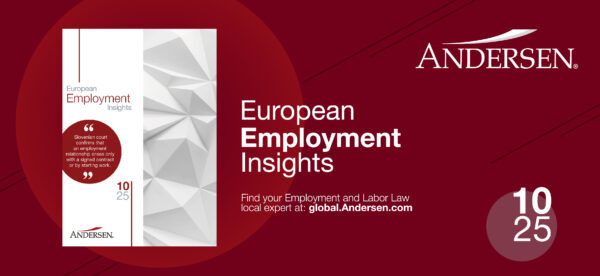
European Employment Insights | October 2025 Employment Andersen's European Employment Law practice presents the October edition of its monthly newsletter READ MORE >>
M&A and PE in Europe: Q3 Results and Forecasts Corporate and M&A Trends in Europe in M&A and private equity in the third trimester of 2025 READ MORE >>
September 2025 | European IP, ICT & DATA Insights Technology and Telecommunications, Intellectual and Industrial Property Andersen’s IP, ICT & Data Service Line has released the 2nd Edition Newsletter READ MORE >>
European Employment Insights | September 2025 Employment Andersen's European Employment Law practice presents the September edition of its monthly newsletter READ MORE >>
European Newsletter: Step in Tax Tax Tax experts are launching the newsletter Step in Tax READ MORE >>
European Employment Insights | August 2025 Employment Andersen's European Labour Law Practice presents the August edition of the monthly newsletter READ MORE >>
European Employment Insights | July 2025 Employment Andersen's European Labour Law Practice presents the July edition of the monthly newsletter READ MORE >>
M&A and PE in Europe: Q2 Results and Forecasts Corporate and M&A The newest edition highlights Q2 2025 M&A and PE trends in Europe READ MORE >>
Energy Performance Contracts (EPCs): a pathway to sustainable energy solutions Energy & Natural Resources The report explores the growing importance of EPCs as a strategic tool to drive energy efficiency READ MORE >>
Europe questions the taxation of homes used as primary residences by taxpayers under the expatriate regime (Beckham Law) Tax The European Union considers the allocation of property income to the personal income tax of primary residences of taxpayers under the Beckham regime to be discriminatory. READ MORE >>
European Employment Insights | June 2025 Employment Andersen's European Labour Law Practice presents the June edition of the monthly newsletter READ MORE >>
Short-term Rentals: New Data Obligations and Registration Requirements German Desk Individuals Harmonized standards of Regulation (EU) 2024/1028, published in April 2024. READ MORE >>
European Employment Insights | May 2025 Employment Andersen's European Labour Law Practice presents the May edition of the monthly newsletter READ MORE >>
M&A and PE in Europe: Q1 Results and Forecasts Corporate and M&A The newest edition highlights Q1 2025 M&A and PE trends in Europe READ MORE >>
European Employment Insights | April 2025 Employment Andersen's European Labour Law Practice presents the April edition of the monthly newsletter READ MORE >>
Newsletter Litigation and Arbitration Europe: Dispute in Construction Contract Litigation and Arbitration Our latest Litigation and Arbitration Newsletter is now available READ MORE >>
European Employment Insights | March 2025 Employment Andersen's European Labour Law Practice presents the March edition of the monthly newsletter READ MORE >>
Newsletter Private Client Services | March 2025 Tax, PCS, Wealth Management & Family Business Andersen's Private Client Services group analyses tax developments for 2025 READ MORE >>
Andersen | Dismissals Guide 2025 Employment This comprehensive guide provides valuable insights into dismissal procedures across Europe READ MORE >>
European Employment Insights | February 2025 Employment The February edition of our Andersen European Employment Insights newsletter READ MORE >>
Income Tax on Natural Persons (IRPF) Tax, German Desk Individuals Are you a tax resident in Spain? Do you receive income from work (such as wages or pensions), interest or other income that would have to be declared on the Individual Income Tax Return (IRPF)? READ MORE >>
Posting workers to Spain Employment, German Desk Business What requirements must be met for a posting of workers to Spain? READ MORE >>
Register of Accredited Companies (REA) German Desk Business Foreign general contractors and subcontractors in the construction sector who, in the context of the cross-border provision of services, decide to post workers to Spain must comply with two measures of labour-law nature to the Spanish authorities before starting business activities READ MORE >>
Form 720, the declaration of assets and rights abroad for residents in Spain Tax, German Desk Individuals Since 2012, residents in Spain are obliged to file form 720. This is an informative declaration of assets and rights located abroad. It is filed between 1 January and 31 March of the year following the year to which the information provided refers. READ MORE >>
M&A and PE in Europe: Q4 Results and Forecasts Corporate and M&A The newest edition highlights Q4 2024 M&A and PE trends in Europe, offering key insights into the current landscape READ MORE >>
European Employment Insights. December 2024 Employment Andersen's European Employment Law practice presents the december edition of its monthly newsletter, which covers the latest and most important developments in employment law READ MORE >>
Working from home in Spain – legal and tax basics Employment The digitalisation of the working environment is advancing. More and more employees and self-employed persons have the opportunity to work from home or almost anywhere else. READ MORE >>
Key aspects of the Beckham Law Tax, German Desk Individuals Spain has a highly attractive tax regime for workers, professionals, entrepreneurs and company administrators relocated to Spain. READ MORE >>
Buying and selling a second hand yacht: Legal and tax aspects German Desk Individuals In Spain, the sale and purchase of ships and yachts is regulated by Law 14/2014 of 24 July on Maritime Navigation. This regulation is of a dispositive nature. READ MORE >>
Wealth tax German Desk Individuals Individuals resident in Spain, with respect to their worldwide assets, as well as non-residents with assets located or rights exercisable in Spanish territory may be obliged to file a Wealth Tax return and pay the corresponding tax. The official tax return form is 714. READ MORE >>
Contracts for executive employees German Desk Business The "Estatuto de los Trabajadores" (ET), the most important regulation in the field of labour law in Spain, basically distinguishes between two types of employment relationship: general and specific. One of these special employment relationships is that of the so-called executive employees. READ MORE >>
Basics of Spanish labour law German Desk Business We provide, without claiming to be complete, an initial overview of the basic principles of labour law relevant to your business activities in Spain. The focus is on the topics that have proven to be particularly relevant in practice. READ MORE >>
Guide to buying Real Estate in Spain German Desk Individuals Buying a property in Spain is really a standard process, but at the same time complex when buyers come from a different legal culture. READ MORE >>
European Employment Insights. November 2024 Employment Andersen's European Employment Law practice presents the november edition of its monthly newsletter, which covers the latest and most important developments in employment law READ MORE >>
Bereavement benefits: what are survivors entitled to in Spain? German Desk Individuals The Spanish National Social Security Institute (Instituto Nacional de la Seguridad Social, hereinafter 'INSS') provides various social benefits in the event of the death of a spouse, partner, parent or close relative. READ MORE >>
Real Estate Finance Lease and Mortgage Lending: Differences in Taxation Tax, German Desk Business There are two main types of financing available to companies that plan to acquire real estate for their activity: purchase with a mortgage loan, which is the traditional method, and real estate finance lease (also known as real estate capital lease). READ MORE >>
Litigation and Arbitration Newsletter | October 2024 Litigation and Arbitration This edition highlights the benefits of mediation as a collaborative alternative to traditional litigation READ MORE >>
European Employment Insights | October 2024 Employment Andersen's European Employment Law practice presents the October edition of its monthly newsletter, which covers the latest and most important developments in employment law READ MORE >>
European IP, ICT and Data Insights | October 2024 Technology and Telecommunications, Intellectual and Industrial Property This edition covers significant new laws and regulations introduced in 2024, landmark rulings in IP and ICT, and the legal challenges posed by Artificial Intelligence READ MORE >>
European Employment Insights September 2024 Employment Andersen's European Employment Law practice presents the September edition of its monthly newsletter, which covers the latest and most important developments in employment law READ MORE >>
Newsletter Private Client Services | Third quarter 2024 Tax, PCS, Wealth Management & Family Business The new edition of the PCS newsletter, prepared by the Private Client Services group, includes the main tax news for the third quarter of 2024 READ MORE >>
European Employment Insights August 2024 Employment Andersen's European Employment Law practice presents the August edition of its monthly newsletter, which covers the latest and most important developments in employment law READ MORE >>
Corporate and M&A Magazine: M&A and PE in Europe: Q2 Results and Forecasts This magazine is key to staying up to date on the current status and forecast of the M&A and Private Equity market in Europe READ MORE >>
Europe after Directive (EU) 2019/1023 of 20 June 2019: A comprehensive European Guide Restructuring and Special Situations Directive 2019/1023 aims to harmonize and modernize restructuring and insolvency frameworks across EU member states. This publication reviews the varying legal frameworks in different EU countries and some non-EU jurisdictions READ MORE >>
European Employment Insights July 2024 Employment Andersen's European Employment Law practice presents the July edition of its monthly newsletter, which covers the latest and most important developments in employment law READ MORE >>
EU Artificial Intelligence Act: Key Considerations for Data Protection Officers Technology and Telecommunications, Intellectual and Industrial Property Andersen's IP, IT, and Data Protection Service Line is excited to announce the release of their new publication, EU Artificial Intelligence Act: Key Considerations for Data Protection Officers READ MORE >>
European Guide to Support Employers: Remote Work in Europe 2024 Employment Andersen's Employment and Labor Law Service line is thrilled to present their new edition of their European Guide to Support Employers, focused on Remote work in Europe READ MORE >>
European Employment Insights June Employment Andersen's European Employment Law practice presents the June edition of its monthly newsletter, which covers the latest and most important developments in employment law READ MORE >>
Andersen up to date | Employment news | June Employment Andersen's Employment team analyses the most interesting regulations and rulings in June READ MORE >>
China Desk Newsletter | May 2024
China Desk Newsletter | May 2024 Employment, Tax, Real Estate, Technology and Telecommunications, China Desk Andersen's China Desk team analyzes the most relevant judgments of May in financial regulation, data protection, tax, labour and real estate READ MORE >>
European Employment Insights May Employment Andersen's European Employment Law practice presents the May edition of its monthly newsletter, which covers the latest and most important developments in employment law READ MORE >>
Andersen up to date | Employment news | May Andersen's Employment team analyses the most interesting regulations and rulings in May READ MORE >>
Newsletter Private Client Services | First quarter 2024 Tax, PCS, Wealth Management & Family Business The new edition of the PCS newsletter, prepared by the Private Client Services group, includes the main tax news for the first quarter of 2024 READ MORE >>
European Employment Insights April Employment Andersen's European Employment Law practice presents the April edition of its monthly newsletter, which covers the latest and most important developments in employment law READ MORE >>
Technology | Revolution of the World Wide Web Technology and Telecommunications The Andersen EU Technology team prepared an insight on the revolution of the World Wide Web READ MORE >>
Litigation and Arbitration Newsletter March Litigation and Arbitration Andersen's Litigation and Arbitration Service Line presents their most recent newsletter: Digitization of proceedings conducted before EU Courts READ MORE >>
European Employment Insights March Employment Andersen's European Employment Law practice presents the March edition of its monthly newsletter, which covers the latest and most important developments in employment law READ MORE >>
European Employment Insights February Employment Andersen's European Employment Law practice presents the February edition of its monthly newsletter, which covers the latest and most important developments in employment law READ MORE >>
Crypto taxation under the Beckham Law Tax Procedure, Tax Tax and Tax Procedure Team analyses the taxation of cryptocurrencies under the Beckham Act READ MORE >>
China Desk Newsletter
China Desk Newsletter | December 2023 China Desk, Corporate and M&A Andersen's China Desk team analyzes the most relevant judgments in Artificial Intelligence, Tax and Corporate matters READ MORE >>
European Employment Insights December Employment December edition of the Andersen Employment and Labor Law Service Line monthly newsletter READ MORE >>
November European Employment Insights Employment November edition of the Andersen Employment and Labor Law Service Line monthly newsletter READ MORE >>
Incentives Renewables & Energy Efficiency Customs and Excise A comprehensive overview of policy frameworks and incentives relevant to enhancing investments in energy efficiency and renewable energy production, prepared by the Business Incentives & Tax Credits EU Service Line READ MORE >>
Note regarding the new Decree Law of the Generalitat that regulates apartments for tourist use Real Estate, Corporate and M&A, Urban planning The new legal regime will be applied in numerous municipalities, including Barcelona, its metropolitan area and important tourist areas in Catalonia. READ MORE >>
European Employment Insights | October 2023 Employment Andersen's European Employment Insights second edition READ MORE >>
European Guide to Tax Regime for Holding Companies Tax A document prepared by the EU International Taxation Service Line to explore the changing tax environment for holding companies in various jurisdictions READ MORE >>
Transfer Pricing | Documentation requirements in Europe Tax, Transfer Pricing The EU Transfer Pricing SL guide on TP documentation requirements in various jurisdictions READ MORE >>
Artificial Intelligence Act: what’s new? Technology and Telecommunications An insight prepared by the EU Technology Industry Group in collaboration with the IP, IT, Data Protection EU Service Line of Andersen, on AI Act READ MORE >>
September 2023 | Latam Corporate Insights Corporate and M&A, Energy & Natural Resources, Cuban Desk An opportunity guide about: The Corporate M&A legal and tax framework focused on the Energy industry across LatAm READ MORE >>
European Corporate Insights – EU Supply Chain Act | July 2023 Edition Corporate and M&A This edition focuses on key topics like human rights compliance, environmental standards, and responsible corporate governance practices to drive a fairer and more sustainable global economy READ MORE >>
European Guide to Support Employers | Employment of Managing Directors Employment This comprehensive guide provides a detailed overview of regulations and conditions surrounding the employment and appointment of managing directors within limited liability companies (LLCs) in over 30 European countries READ MORE >>
M&A and PE Market Trends Semester 1 Europe Corporate and M&A Target M&A hit a 10-year low, dropping by 49% compared to 2022 levels READ MORE >>
China Desk Newsletter
China Desk Newsletter | July 2023 Corporate and M&A, China Desk Andersen's China Desk team analyzes the most relevant judgments in tax, real estate, corporate and M&A matters READ MORE >>
VAT Treatment of tokens Tax Andersen’s VAT & Customs practice in Europe conducted a comprehensive analysis of the VAT treatment of various types of tokens READ MORE >>
ECJ allows proportional VAT fines Tax The EU VAT & Customs Service Line has prepared an alert about the recent ruling by the European Court of Justice (ECJ) that has shed light on the issue of proportional fines for underpaid VAT in Belgium READ MORE >>
The new Carbon Border Adjustment Mechanism (“CBAM”) | Analysis, implications and impact Tax, Public and Regulatory, Energy & Natural Resources, Customs and Excise Andersen's Public & Tax team analyses the impact and implications of CBAM READ MORE >>
Newsletter Private Client Services | May 2023 Tax The May edition of the PCS newsletter, written by the Private Client Services group, includes the main developments in tax matters in recent months. READ MORE >>
Transfer Pricing and Sustainability Tax The European Transfer Pricing Team at Andersen has developed a news article on ethical tax practices for multinational businesses (MNEs) READ MORE >>
Beyond the Hype: Real-World Applications of AI Technology and Telecommunications The Andersen European Technology Industry Group, led by Francesco Marconi, has recently issued a document discussing the rapid growth of Artificial Intelligence (AI) and its impact on our daily lives. READ MORE >>
M&A and PE Market Trends Q1 Europe Corporate and M&A Andersen's European M&A team analyses trends in the European mergers and acquisitions market READ MORE >>
M&A Full Year Review: Trends in Mergers and Acquisitions Corporate and M&A Andersen's M&A team in Europe analyses trends in mergers and acquisitions READ MORE >>
Litigation & Arbitration | Post M&A Disputes and Current Challenges Litigation and Arbitration Andersen's Arbitration and Litigation team analyses issues related to disputes in post-M&A transactions, what the causes of disputes may be, what the jurisdiction of the ordinary courts is, and whether arbitration is better in such situations. READ MORE >>
Andersen Employment Brief | March 2023 Employment Andersen's Employment team analyses the most relevant legilation and judgemnts in the March brief READ MORE >>
China Desk Newsletter
China Desk Newsletter | March 2023 Corporate and M&A, China Desk Andersen's China Desk team analyzes the most relevant judgments of February in employment, tax, real estate, corporate and M&A matters READ MORE >>
Transfer pricing year-end adjustments Tax Our European Transfer Pricing team has prepared a short summary on the topic "Transfer pricing year-end adjustments" READ MORE >>
European Guide to Support Employers – Remote Work in Europe Employment Remote work is a rapidly growing trend in the European job market. Much has changed in the last two years, not only in the job market but also in the legislation of individual countries. READ MORE >>
Andersen Employment Brief | February 2023 Real Estate, Real Estate, Construction and Urban Planning Andersen's Employment team analyzes the most interesting regulations and rulings of February. Victoria Caldevilla delves into the comment of the month on "New offences of the corporate entities" READ MORE >>
European Corporate Insights | January 2023 Corporate and M&A, Energy & Natural Resources The new edition of European Corporate Insights provides a comprehensive analysis of regulatory trends and measures in the energy sector in 15 European countries READ MORE >>
Hot spots in Employment Law | January 2023 Employment Our team analyses the main novelties you need to know about employment issues in January READ MORE >>
First court sentence conviction by a US court related to Title III of the Helms-Burton Act Cuban Desk First court sentence conviction by a US court related to Title III of the Helms-Burton Act READ MORE >>
R&D Incentives Reference Guide Tax Guide on R&D incentives for the European service line Business Incentives and Tax Credits READ MORE >>
The M&A market in Europe: 2022 and expectations Corporate and M&A Our M&A experts analyze key insights and factors that influenced the M&A market: 2022 and expectations READ MORE >>
Andersen Employment Brief | November 2022 Employment Andersen's Employment team analyses the most relevant legilation and judgemnts in October's brief. In it, Marta Navarro, delves into the comment of the month on "The shocking volatility of permanent seasonal employment contract" READ MORE >>
Litigation & Arbitration Service Line Newsletter: Rebus sic stantibus and force majeure clause Litigation and Arbitration Andersen´s European Litigation & Arbitration Newsletter is dedicated to an extraordinary change in economic relations READ MORE >>
Andersen Employment Brief | October 2022 Employment Andersen's Employment team analyses the most relevant legilation and judgemnts in October's brief. In it, Raquel de la Viña, delves into the comment of the month on "The shocking volatility of permanent seasonal employment contract" READ MORE >>
Hot spots in Employment Law | October 2022 Employment Our team analyses the main novelties you need to know about employment issues in October READ MORE >>
New US court decision rejects alleged “trafficking” under Title III of the Helms Burton Act Cuban Desk New US court decision rejects alleged "trafficking" under Title III of the Helms Burton Act READ MORE >>
Cuba opens foreign investment to the retail and wholesale sector-Andersen Cuban Desk With this new step, foreign investors will be able to manage the direct marketing of their products in retail and wholesale markets READ MORE >>
European Corporate Insights | July 2022 Corporate and M&A In this publication we address “Doing Business in uncertain times” as one of the topics that have special interest for companies with multinational activities, and especially those doing business in Europe READ MORE >>
The impact of sanctions adopted for the war against Ukraine and the expected increase in arbitrations Litigation and Arbitration Overview of the sanctions in place to date, potential impact on the business of companies and some guidance in relation to the management and resolution of disputes arising from the imposition of such sanctions READ MORE >>
Volatility: a plug for M&A transactions? Corporate and M&A Andersen´s M&A practice in Europe analyzed the Volatility in the market and the key factors to mitigate risks in M&A transactions READ MORE >>
Transfer pricing and financial transactions Tax Andersen's EU Transfer Pricing department has prepared a document with the most relevant and common TFs identified in the OECD guidance READ MORE >>
Measures carried out by the Algerian State and their impact on diplomatic relations with Spain Litigation and Arbitration On June 8th, the Algerian government announced the immediate suspension of the Treaty of friendship, good neighborliness and cooperation between the Kingdom of Spain and the Democratic Republic of Algeria. The following is an analysis of how this decision affects companies that have commercial relations with Algeria and Spanish companies with investments in the Algerian state READ MORE >>
Input tax refund – formally insufficient invoices do not necessarily lead to the exclusion of the input tax deduction Tax In the recent past, there have been a large number of ECJ rulings which have been aimed at ensuring that formally defective (or even missing) invoices do not necessarily lead to the exclusion of the input tax deduction READ MORE >>
Declaration for the Future of the Internet LegalTech y NewLaw The United States and 60 other global partners present the 'Declaration for the Future of the Internet' READ MORE >>
Another positive ruling of the ECJ concerning fixed establishment Tax On 7 April 2022, the European Court of Justice issued a verdict in the Romanian case Berlin Chemie (C-333/20) READ MORE >>
The Supreme Court Addresses Inheritance Tax to Beneficiaries Resident For Tax Purposes In Third Countries Tax Regarding the recent judgment of the Supreme Court ("TS") of 6th April 2022 READ MORE >>
The European Court of Justice has ruled on warranty repairs Tax Repair under warranty completed by the customer may be considered as a supply of services towards the vendor, with repair costs might qualifying as consideration READ MORE >>
The new national security scheme: application to private sector companies LegalTech y NewLaw On Royal Decree 311/2022 regulating the National Security Scheme (ENS) READ MORE >>
Digital security aspects included in the European Union’s Strategic Compass Litigation and Arbitration, LegalTech y NewLaw A Strategic Compass to strengthen the EU's security and defence by 2030 READ MORE >>
New decision by the Southern District Court of Florida recognises the Helms Burton Act’s definition of “trafficking” as constitutional Cuban Desk On March 23, 2022, a judge of the Southern District Court of Florida issued a new ruling recognising that the definition of "traffic" included in the Helms Burton Act (HBL) is constitutional READ MORE >>
The Whistleblower Directive in Europe | March 2022 Employment Andersen´s European Employment practice has prepared a new edition of the European Employment Newsletter focused on the Whistleblower Directive READ MORE >>
European Corporate Insights | March 2022 Corporate and M&A, Banking and Finance The fifth edition of the European Corporate Insights magazine is focused on the Banking and Finance Industry with the principal topic ‘SANDBOX in Europe’ READ MORE >>
Judgment of the Court of justice of the European Union Case C-788/19 Implications for the holding of assets abroad and their regularisation Tax Regarding the ruling of the Court of Justice of the European Union (“CJEU”) on 27th January READ MORE >>
The M&A market in Europe has reached an all time record in 2021 Corporate and M&A Andersen´s M&A practice in Europe analyzed the growth of M&A during 2021 READ MORE >>
The Spanish Supreme Court Confirms the National Court Criterium Stating that Offset Of Nols is a Right, not a Tax Option with a Submission Deadline Tax Regarding the Supreme Court's ruling of November 30, 2021 READ MORE >>
Main novelties of the Startups Act Tax, Corporate and M&A On 27-12-2021, the Official Gazette of the Spanish Parliament published the Draft Law on the promotion of start-ups, known as the “Start-ups Law” READ MORE >>
The Whistleblowing Channel: Enhanced whistleblower protection begins Employment The deadline for Spain, as an EU Member State, to transpose Directive (EU) 2019/1937 of the European Parliament and of the Council of 23 October 2019 on the protection of persons reporting breaches of Union law has expired READ MORE >>
Impact of ESG on M&A activity and investment decisions Corporate and M&A Andersen´s M&A practice in Europe analyzed the importance of ESG criteria in M&A READ MORE >>
The Resilience and Recovery Guide Tax Andersen´s Business Incentives and Tax Credits practice developed The Resilience and Recovery Guide READ MORE >>
New Portfolio of Opportunities for foreign investment in Cuba Cuban Desk The Cuban authorities update the Portfolio of Opportunities for Foreign Investment in Cuba in order to inform foreign investors about new projects of interest READ MORE >>
Agri-food Insights | November 2021 Agrifood Latest developments impacting on the agri-food sector, specifically the new Common Agricultural Policy (CAP), new amendments to the Food Chain Act, new trends in investment and profitability, among others. READ MORE >>
European Corporate Insights | November 2021 Corporate and M&A The new edition of our #EuropeanCorporateInsights magazine provides an overview of the latest #ESG developments specific to different European jurisdictions READ MORE >>
Global Transfer Pricing Insights | October 2021 Tax, Transfer Pricing In this publication, Andersen Global's Tax team provides a guide to understanding the transfer pricing rules, regulations, policies and practices of the jurisdictions covered READ MORE >>
The Possibility of foreign investment in MSMEs in Cuba Cuban Desk New regulations associated with the establishment of MSMEs in Cuba, which open up the possibility for Cubans to create their own businesses and contribute to the island's economic development READ MORE >>
Limited Liability Companies in Europe Corporate and M&A New Andersen Guide with an overview on Limited Liability Companies in Europe, its formation and incorporation procedures with a dedicated section for each of the European countries covered in this Guide READ MORE >>
Updates on the extension of ERTEs, riders’ employment rights and the interprofessional minimum wage Employment Andersen's labor team summarizes the main novelties that each of these regulations include in labor and social security matters READ MORE >>
New measures in Cuba on the exercise of private activity Cuban Desk On August 19, 2021, the regulations governing the exercise of private activity, including (i) self-employed workers, (ii) MSMEs and (iii) non-agricultural cooperatives, were published in the Official Gazette of Cuba No. 94 Ordinary READ MORE >>
Helms Burton Act: new lawsuit under Title III and appeal in favour of American Airlines Cuban Desk The Court argues that if the property giving rise to the claim was seized prior to March 12, 1996, a U.S. national cannot bring an action under the HBA unless he acquired title to his right to the claim prior to March 12, 1996 READ MORE >>
Relevant information for employers regarding the vaccination certificate Employment Andersen´s European Employment Practice, has prepared this edition of the Newsletter providing an overview of 21 countries with the most common questions employers have regarding the vaccination certificate READ MORE >>
European Corporate Insights | July 2021 Corporate and M&A In this publication Andersen´s European Corporate and M&A practice address “How to Finance M&A transactions in Europe" READ MORE >>
The figure of the Investor in the Draft Bill for the promotion of the startup ecosystem Tax, Corporate and M&A The Government approves the Draft Bill on Startups, which aims to boost investment in the entrepreneurial ecosystem in Spain through tax benefits, investment support instruments and attracting talent. Javier Bustillo and Borja De Gabriel analyse the measures adopted and what they imply for this type of companies and their investors READ MORE >>
The case against Pernod Ricard, S.A. is dismissed under Title III of the Helms-Burton Act Cuban Desk In this lawsuit, the defendant was accused of engaging in "trafficking" with respect to assets confiscated from the plaintiffs' family by the Cuban government after 1st January 1959 READ MORE >>
Cuba updates the system of foreign company commercial representation Cuban Desk On June 7th 2021, a batch of standards was published in the Ordinary Official Gazette of the Republic of Cuba No. 63, updating the legal regime of branches and representations of foreign companies READ MORE >>
Helms Burton Title III plaintiffs reach settlement with defendant LafargeHolcim Cuban Desk The lawsuit, filed by the Clafin family, was based on the use of property confiscated by the Cuban government READ MORE >>
New lawsuit under Title III of Helms-Burton between sugar mills. Francisco Industries, Inc. v. ASR Group International, Inc. Cuban Desk The lawsuit alleges that ASR has engaged in "trafficking" because it knowingly and intentionally profited from the assets once confiscated from the defendant through its business activity READ MORE >>
Proceedings against Meliá regarding the management of hotels on Cuban soil are closed for lack of jurisdiction of Spanish courts Cuban Desk Although the Spanish courts have been the connoisseurs of the matter and the legal arguments used are in accordance with Spanish regulations, this lawsuit has been contextualized with the activation by the government of Donald Trump of Title III of the Helms Burton Law in 2019 READ MORE >>
The EU Proposal for a new Artificial Intelligence regulation establishes a new legal framework for innovation Technology and Telecommunications, AI and Regulatory Compliance The European Commission frames the AI standard within the European digital strategy called "Shaping Europe's Digital Future" READ MORE >>
Latest court decision in Exxon v. CIMEX and CUPET lawsuit under Title III of the Helms-Burton Act Cuban Desk The Court analyses the exemption of foreign states from immunity from prosecution and calls for evidence to clarify the application of the commercial activity exception READ MORE >>
Requirements and obligations of employers in relation to COVID-19 vaccines Employment Andersen's European Employment Group has prepared this 20-country summary that addresses frequently asked questions employers have regarding the COVID-19 vaccine READ MORE >>
Helms Burton lawsuit against Tripadvisor, Booking, Expedia & Visa, Mastercard dismissed at first instance Cuban Desk The main reason for the Court's decision to dismiss the claim is that the LHB requires the Claimant to have acquired title to the claim to the confiscated property prior to 12th March 1996 READ MORE >>
Guide to provide an overview of termination procedures for employees in 21 European countries Employment The European Employment Group of Andersen has developed a practice guide with an overview of the most relevant aspects of dismissals regulations in 21 European countries. READ MORE >>
New lawsuit under Title III of the Helms-Burton Act Cuban Desk Against a Singapore company READ MORE >>
The United States-Cuba Trade Act Of 2021 Cuban Desk The bill aims to reestablish normal trade relations between Cuba and the U.S. READ MORE >>
The EU requires that 70% of non-reimbursable financial aid from European funds be committed by 2022 Public and Regulatory The Regulation creates the Recovery and Resilience Mechanism with the objective of providing financial assistance to Member States to achieve the reforms and investments set out in the national recovery and resilience plans READ MORE >>
VAT Refund procedure to businesses or entrepreneurs established in the territories of the United Kingdom of Great Britain and Northern Ireland Tax Resolution of the Directorate General for Taxation of the 4th January 2021 READ MORE >>
New regulation on access and connection to the energy transmission and distribution networks Energy & Natural Resources In the light of Royal Decree 1183/2020 of 29th December on access and connection to the electricity transmission and distribution networks, with the intention of adapting to EU requirements and facing up to the new reality of the sector READ MORE >>
Tax measures incorporated in the State Budget Law for 2021 Tax Law 11/2020 of 30th December on the General State Budget for 2021 (hereinafter, "LPGE") was published in the Official State Gazette of 31st December 2020. The purpose of this Informative Note is to set out the main tax measures established by the LPGE, which have generally come into force as from 1st January 2021 and […] READ MORE >>
Impact on international transfers of the EU-UK Trade and Cooperation Agreement Technology and Telecommunications The Trade and Cooperation Agreement between the United Kingdom and the European Union was published on 23rd December to regulate relations from 1st January 2021.  Regarding transfers of personal data from the European Union to the United Kingdom, the Agreement provides, in summary, for the following: (i) They will not be considered as international transfers […] READ MORE >>
NI GA 33/2020 of 11 December on returnable packaging Tax On 11th November 2020, the AEAT Customs and Excise Department published Information Note NI GA 33/2020 of 11th December on returnable packaging in relation to packaging that may be exported and subsequently re-imported into the customs territory of the Union, clarifying the formalities required for operators to benefit from the import duty exemption applicable on […] READ MORE >>
The Supreme Court recognises the power of the administration to impose emission limit values in an IEA even though they are not covered by a previous standard Energy & Natural Resources Regarding the High Court's judgment of 3rd November 2020 READ MORE >>
Time limit for applying for registration and/or exercising certain options for VAT purposes Tax The purpose of this note is to recall that, during November 2020, certain benefits and obligations may be claimed for VAT purposes, with effect from 1st January 2021. Regarding the refund scheme for input and non-deducted VAT, as a rule, taxable persons may request a refund of input and non-deducted VAT in the statement-settlement for […] READ MORE >>
European Corporate Legal Insights | Applicable Law to Distribution Agreements in different European countries Corporate and M&A The second edition of European Corporate Legal Insights, the magazine published by Andersen's Corporate Legal Service Line in Europe, analyzes all of these issues to be taken into account in distribution agreements in different European countries READ MORE >>
The United Kingdom agrees to provide 100% support for customs improvement and automation Tax To facilitate change in the internal processes of UK-based companies, the UK government has approved a £50 million direct aid scheme with retroactive effect from 12th June 2020 READ MORE >>
The deadline for waiving applications and permits for access and connection ends Energy & Natural Resources Regarding Royal Decree-Law 23/2020 of 23rd June, which approves measures in the field of energy and other areas for economic recovery and establishes that 25th September will be the deadline for renouncing applications and permits for access and connection, without the seizure of guarantees READ MORE >>
Nullity of dismissal due to situation of Temporary Incapacity Employment Regarding the Judgment of the High Court of Justice of Galicia dated June 9th 2020 READ MORE >>
European Corporate Legal Insights | July 2020 Corporate and M&A Analysis of the restrictions on foreign investment from the COVID-19 crisis adopted by European countries. READ MORE >>
The Council of the European Union postpones the implementation date of the VAT package for e-commerce Tax On 22nd July, the Council of the European Union published a Decision amending Directives EU 2017/2455 and 2019/1995 regarding the deadline for implementation of the two Directives by the Member States. Both Directives substantially changed the distance selling regime and introduced simplification measures mainly affecting cross-border e-commerce either between other Member States or with third countries. Both […] READ MORE >>
When is it necessary to appoint a Data Protection Officer? In the wake of the first sanction by the Spanish Data Protection Agency Technology and Telecommunications The appointment of a DPO is not mandatory for all companies, although it is advisable to have a DPO in any organization that handles a significant amount of personal data READ MORE >>
Financial securites and transfer pricing Tax, Transfer Pricing Securities are instruments designed to ensure greater safety and coverage for the fulfilment of the obligations covered. For example, securities ensure the creditor institutions that the lender will comply with certain financial obligations in case the borrower is not able to bear the costs. In this case, additionally, the debtor of the main operation subject […] READ MORE >>
Collective bargaining agreement applicable to multi-service companies without their own company agreement Employment Regarding the High Court's Ruling of 11th June 2020 READ MORE >>
Change affecting stamps for distilled beverages Tax Order HAC/626/2020, of 6 July, amending Order HAC/1271/2019, of 9 December, approving the rules for the implementation of Article 26 of the Regulation on Excise Duties READ MORE >>
Leaving your post to commit a criminal act Employment Regarding the Judgment of the High Court of Justice of Extremadura of 11th February 2020 READ MORE >>
Preliminary draft Law on Waste and Contaminated Soils Tax On Tuesday, June 2, 2020, the Council of Ministers approved the draft of Law on Waste and Contaminated Soils, implementing the modifications introduced by Directive (EU) 2018/851 of the European Parliament and of the Council of 30 May 2018, which amended Directive 2008/98 / EC on waste as well as the so-called Directive on single-use […] READ MORE >>
Calculation of pro rata for Value Added Tax of Holding Companies in subsidiary share transactions Tax In May, the Supreme Court published two rulings -18th May SCR 428/2020 and 19th May SCR 483/2020- aimed at clarifying how the pro rata for value added tax of holding companies in certain transactions with their subsidiaries should be calculated READ MORE >>
Amendment of the European Commission’s Temporary Framework for State aid and recapitalisation or nationalisation plans Competition and EU law On 20th March 2020, in view of the exceptional nature of the situation caused by the COVID-19 pandemic, a communication from the European Commission was published in the Official Journal of the European Union setting out the so-called Temporary Framework for State aid measures to support the economy in the context of the current COVID-19 […] READ MORE >>
Amendments to the Financial Transactions Tax Bill published Tax On 13th May, the amendments to the Financial Transactions Tax ("FTT") Bill were published in the Official Gazette of the Spanish Parliament and will be the subject of a new plenary session for debate and voting in order to continue their processing. The VOX, Ciudadanos and Popular parliamentary groups have submitted refund amendments to the […] READ MORE >>
Possible impact on the agri-food sector of the imprint of non-traditional brands Agrifood Arising from the transposition of the Community Trademark Directive 2015/EU/2436, the Spanish Trademark Law 17/2001, hereinafter Law 17/2001, had to modify some of its articles. Among them, the article referring to the opening of the concept of trademarks, to include non-traditional trademarks, which have been imposed on the market, mainly due to the advance of […] READ MORE >>
Lack of respect and consideration for co-workers Employment Regarding the December 5th 2019 Ruling of the High Court of Justice of Aragon READ MORE >>
Compensation following the requisition of property or rights of individuals due to the state of alert Public and Regulatory Analysis of the compensation following the requisition of property or rights of individuals due to the state of alert READ MORE >>
Companies against Covid-19 II Public and Regulatory, Litigation and Arbitration, Employment On March 6th, we were preparing to analyse the legal contingencies that companies should consider in relation to Covid-19. Now, a few days later and amid a health emergency, we are preparing to analyse the measures adopted by the Government this past weekend READ MORE >>
Main measures in the area of taxation and customs and indirect taxation in relation to COVID-19 Tax Regarding Royal Decree 463/2020 declaring the state of alert for health crisis management and Royal Decree-Law 7/2020 adopting a series of measures to respond to the economic impact of COVID-19 READ MORE >>
Royal Decree 463/2020, of 14 March, declaring the state of alert for the management of the health crisis caused by COVID-19 Employment Regarding Royal Decree 463/2020 of 14 March, declaring the state of alert for the management of the health crisis situation caused by COVID-19 READ MORE >>
Urgent fiscal measures adopted in relation to COVID-19 Tax Urgent fiscal measures adopted by the government to respond to the economic impact of COVID-19 READ MORE >>
Coronavirus | Royal Decree-Law 6/2020 of 10th March adopting certain urgent measures in the economic sphere and for the protection of public health Employment Regarding Royal Decree-Law 6/2020 of 10th March READ MORE >>
Strengthening the family business: possibilities, strategies and solutions Litigation and Arbitration  1.- The challenges of the family business It is estimated that more than 85% of all companies in Spain are family businesses, understood as those in which ownership or decision-making power corresponds, totally or partially, to persons with family ties; that is, those in which ownership/management/control is dominated or reserved for the family sphere. In […] READ MORE >>

Application of the adaptation and distribution of the working day ex art. 34.8 Statute of Worker’s Rights to the care of children over 12 years Employment Regarding the main changes introduced by RDL 6/2019 of 1 March READ MORE >>
Transposition of the “Quick fixes” into the Spanish legal system: Amendments to the VAT Law and Regulations Tax Regarding Royal Decree 3/2020 of 4 February READ MORE >>
Proposed reform of the Code of Good Governance for listed companies Corporate and M&A The National Securities Market Commission (CNMV) submitted the proposal to amend certain recommendations of the Good Governance Code for listed companies in force since 2015 to public consultation on the 15th. Among the objectives of the reform are the following: – update some contents of the current Code to adapt them to legal changes that […] READ MORE >>
Taxation of compensation paid under the post-contractual non-competition pact: binding consultation V2736-19 of 8 October 2019 Employment On the subject of the binding consultation V2736-19 of 8 October 2019 READ MORE >>
Main developments in the field of social security introduced by Royal Decree-Law 18/2019 of 27 December Employment With regard to Royal Decree-Law 18/2019 adopting certain measures in the field of taxation, cadastre and social security READ MORE >>
Simplification and harmonisation of VAT on intra-Community goods transactions Tax The date of entry into force of this set of measures is 1 January 2020 and witch modifies the harmonisation and simplification of certain rules for value added tax arrangements in respect of the taxation of trade between Member States READ MORE >>
Special Manufacturing Taxes Tax Order HAC/998/2019, of 23 September, regulating compliance with the obligation to keep accounts of the products covered by the manufacture IIEE READ MORE >>
Guide for EU companies to a possible Hard Brexit Tax Initial analysis of a possible Hard Brexit READ MORE >>
Is your company prepared for the GDPR? Technology and Telecommunications

The new GDPR comes into force on the 25th of May 2018

READ MORE >>
New developments in corporate tax filing Tax

On May 5, by Order HFP/399/2017, the revised Corporate Income Tax forms were approved for the 2016 fiscal year

READ MORE >>
Conference by Íñigo Rodriguez-Sastre in the Club Español del Arbitraje Litigation and Arbitration

Presentation on the admission of evidence obtained in an allegedly unlawful manner in the framework of a conference organised by the Club Español del Arbitraje.

READ MORE >>
Sentence of the ECJ in relation to the VAT exemption in intracommunity operations Tax

The exemption cannot be subject to registration in the Registry of Intracommunity Operators (RIO) or in the VIES

READ MORE >>
New developments in the SII (Immediate Supply of Information on VAT) Tax

Exemption for taxable persons registered with the REDEME from the requirement to file invoicing registers for the first half of 2017

READ MORE >>
The Spanish Supreme Court allows the use of video surveillance Employment

Regarding Video Surveillance Measures for Monitoring Employee Compliance with Work Duties and Norms

READ MORE >>
Court decision of the Constitutional Court in relation to the IIVTNU (Tax on the Increase in Value of Urban Land) Tax

The Constitutional Court declares certain provisions of the “Provincial Law of Guipúzcoa” which regulates the IIVTNU, to be void and unconstitutional

READ MORE >>